Your Ayurveda companion · Ayurvedic Living
Morning Dinacharya
The Morning Tongue Scraping Ritual: Jihwa Prakshalana Decoded
Tongue scraping is a classical Ayurvedic morning step. Small dental trials suggest it reduces the sulfur compounds behind bad breath — but the evidence is low-certainty and short-lived, and detox claims go beyond it.
In short
Tongue scraping — jihva nirlekhana in the classical texts — means drawing a curved scraper across the tongue each morning to remove coating. Dental trials show it lowers the sulfur compounds behind bad breath, slightly better than a toothbrush, but the evidence base is small. Traditional talk of clearing 'ama' is a classical interpretation, not a proven detox mechanism.
What is jihwa prakshalana?
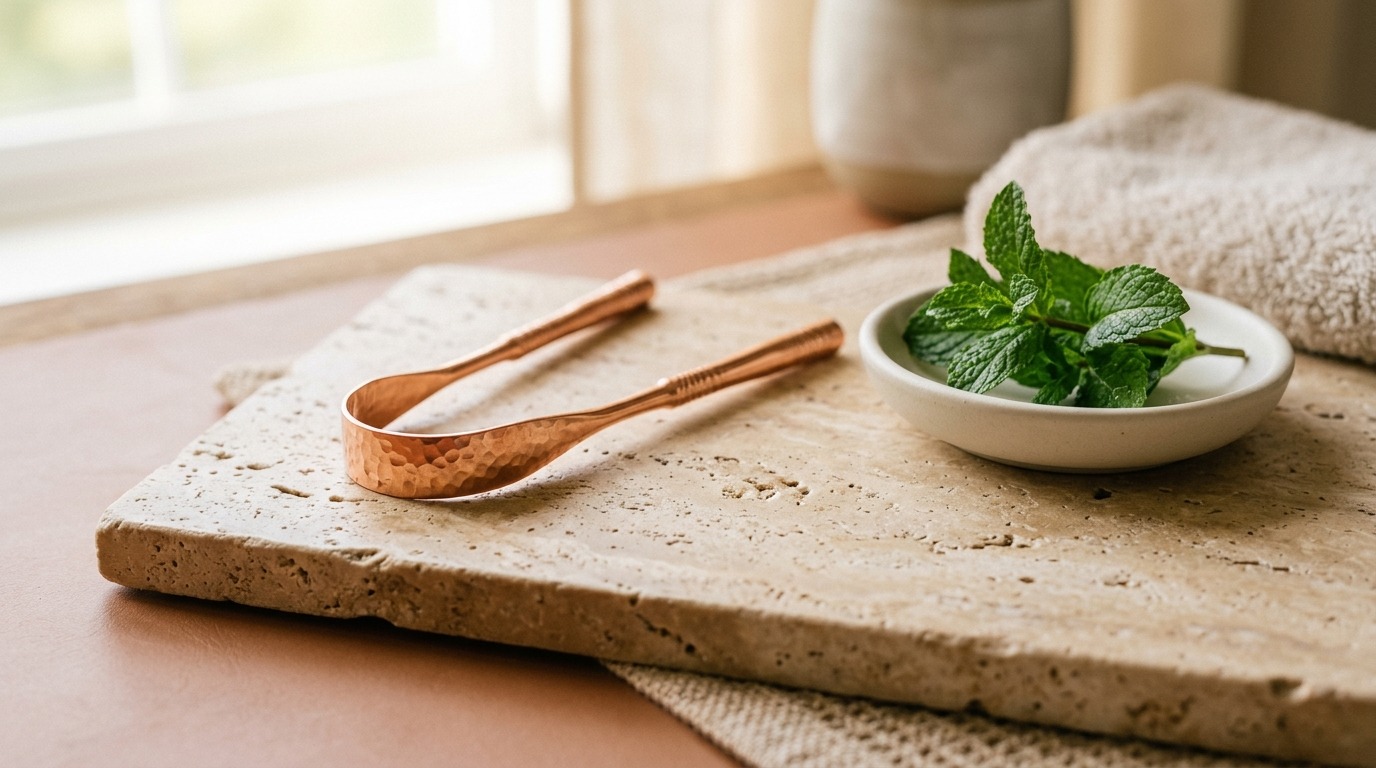
Jihwa prakshalana — more precisely jihva nirlekhana, "scraping/cleaning of the tongue" — is the classical Ayurvedic morning step of drawing a curved scraper across the tongue to remove the overnight coating (Charak Samhita Research Centre)). It sits inside the broader oral-hygiene sequence of dinacharya, alongside cleaning the teeth, washing the mouth and face, and holding oil in the mouth — the JAIMS review of the tradition lists tongue scraping among the standard morning practices (JAIMS).
The classical texts are specific about the instrument: it should be curved and without a sharp edge, and the Charaka Samhita lists metallic scrapers made of gold, silver, copper, tin, or brass (Charak Samhita Research Centre, citing Cha.Sa. Sutra Sthana 5/76)). That is a traditional material preference — worth knowing, because modern marketing sometimes upgrades it into a medical claim it was never tested as.
What is the coating actually made of?
Researchers estimate that about 85% of bad-breath cases originate inside the mouth, and roughly half of those trace to tongue residues, whose bacteria produce volatile sulfur compounds — hydrogen sulfide and mercaptans — the gases people smell as bad breath (Pedrazzi et al., Journal of Periodontology). Dentists describe the coating as a tongue biofilm, and a comparative clinical study framed its goal plainly as removing tongue biofilm to improve breath odor (comparative study of tongue cleaning aids).
In the traditional Ayurvedic view, this same coating is read as a visible sign of ama — incompletely digested or unprocessed residue that the tradition says accumulates overnight (JAIMS). Keep the two frames separate: the biofilm is what microscopes see; ama is how the classical system interprets it. Only the first has been measured in trials.
What do the clinical trials actually show?
The honest summary is "promising but thin." A 2006 Cochrane systematic review found just two eligible trials with 40 participants total (Cochrane). Its conclusion: weak and unreliable evidence of a small but statistically significant reduction in volatile sulfur compounds when tongue scrapers or cleaners were used instead of toothbrushes — and no high-level evidence comparing mechanical cleaning against anything else, like mouthwashes (Cochrane). A later Cochrane review on halitosis interventions reiterated that mechanical tongue cleaning's benefits appear very limited and short-acting (Cochrane 2019).
The individual trials are more encouraging in the short term. In a small crossover clinical trial of 10 healthy adults, a tongue scraper reduced volatile sulfur compounds by 75% versus 45% for a soft toothbrush, measured with a handheld sulfide monitor (Pedrazzi et al., 2004). And in a 2024 controlled, randomized clinical trial, tongue scraping produced an immediate, statistically significant reduction in halitosis readings — though bacterial counts of key periodontal species did not change, suggesting the effect is on the gases, not a lasting bacterial kill (Motta et al., PLOS ONE).
So: small trials suggest scraping reduces the sulfur compounds behind bad breath in the short term, somewhat more than a toothbrush. Nothing in these trials tests "detoxification," endotoxin removal, or digestive benefits — the trial outcomes were volatile sulfur compounds, coating scores, and bacterial counts (Cochrane).
Should you scrape before or after brushing your teeth?
The classical sequence cleans the teeth first and the tongue second — dantapavana precedes jihva nirlekhana in the traditional oral-hygiene order (Charak Samhita Research Centre)). Modern trials offer no tested answer on ordering: the Pedrazzi crossover compared a week of one method against a week of the other, not sequences within a single session (Pedrazzi et al.). Practically, scraping first lets the toothbrush and toothpaste finish the job on a freshly cleared tongue, while brushing first means the scraper removes what the brush loosened. Pick the order you will repeat daily — we found no trial testing which order works better, so consistency is practical advice, not an evidence finding.
Is copper better than steel — or plastic?
Short answer: unproven either way, with one surprise. We did not find a clinical trial testing whether copper scrapers reduce bacteria or improve outcomes compared with stainless steel — the comparative study tested plastic and metal scrapers without singling out copper (comparative study) — and the classical texts recommend the metal without any germ theory behind it (Charak Samhita Research Centre)). Meanwhile, the comparative clinical study that tested a manual toothbrush with a built-in scraper against commercial plastic and metal tongue scrapers found that all reduced coating scores, but plastic cleaners produced the greatest reduction in anaerobic bacterial counts (comparative study).
Practical takeaway: pick a scraper that is smooth, curved, and free of sharp edges — the classical design requirement (Charak Samhita Research Centre)) — in whatever material you will actually use daily. Copper is traditional and fine; stainless steel is a modern alternative that is fine to use; plastic has the only comparative bacterial-load data (comparative study). Anyone selling you copper as a proven antimicrobial mouth therapy is selling beyond the evidence.
How do you do it without hurting yourself?
The technique is simple and the main risk is overdoing it. Extend your tongue, place the scraper toward the back (as far as comfortable without triggering the gag reflex), and draw it forward with light pressure; rinse the scraper and repeat a few times, then rinse your mouth. The caution comes from the trial record: in one Cochrane-included trial, toothbrush-based tongue cleaning caused nausea in 60% of users and minor tissue trauma in 10% (Cochrane) — those events occurred among toothbrush users, not scraper users, but the lesson is light pressure regardless of tool.
Treat scraping as one step in the Ayurvedic morning routine, not a standalone cure: brush and floss as usual, and if bad breath persists, the cause is more likely gum disease, dry mouth, tonsil debris, or reflux than a dirty tongue (Mayo Clinic) — a dentist visit beats a harder scrape. Within the wider dinacharya framework, jihva nirlekhana is a two-minute hygiene habit with modest proven benefit and an honest traditional pedigree. That is enough.
By the Swastik Research Desk. Educational content only — not medical advice. Persistent bad breath, bleeding gums, or mouth sores deserve a dentist's evaluation, not just a scraper.
Frequently asked questions
Does tongue scraping detox the body?
No trial proves that. In the traditional Ayurvedic view, the overnight coating is interpreted as a sign of ama — incompletely processed residue — and scraping is part of the morning cleansing sequence (Charak Samhita Research Centre)). Modern dentistry measures something narrower: volatile sulfur compounds, the gases behind bad breath. Small trials show scraping lowers those gases (Pedrazzi et al.) (Motta et al.). Treat ‘detox’ as classical language, and breath-freshening as the tested effect.
Is a copper tongue scraper better than stainless steel?
There is no clinical evidence that copper scrapers kill germs in the mouth or work better than steel or plastic. Classical texts list gold, silver, copper, tin, and brass as scraper materials — a traditional preference, not an antimicrobial finding (Charak Samhita Research Centre)). One comparative clinical study actually found plastic cleaners reduced tongue bacterial load most (comparative study). Choose a smooth, curved scraper without sharp edges, in whatever material suits you.
Can I just use my toothbrush instead?
You can, and it does something: in a small crossover trial, a toothbrush reduced volatile sulfur compounds by 45% versus 75% for a dedicated scraper (Pedrazzi et al.). A Cochrane review of the two available trials found a small but statistically significant advantage for scrapers over toothbrushes — while calling the overall evidence weak. If you already brush your tongue thoroughly, a scraper is an incremental upgrade, not a revolution.
How many strokes, and how hard should I press?
We did not find a trial establishing an optimal stroke count, so keep it gentle and brief: a few light passes from the back of the tongue toward the front, rinsing the scraper between passes. Aggressive scraping is counterproductive — one trial in the Cochrane review reported nausea in 60% and tissue trauma in 10% of toothbrush users. Light pressure and a curved edge — the classical design requirement (Charak Samhita Research Centre)) — and stop if you gag or see irritation.
Will tongue scraping fix my bad breath permanently?
Probably not on its own. Trials show the benefit is real but short-lived — in one trial, reduced sulfur levels were undetectable 30 minutes after cleaning (Cochrane). A 2024 randomized trial found immediate halitosis reduction but no sustained bacterial-count change (Motta et al.). Persistent bad breath often comes from gum disease, tonsil stones, dry mouth, or reflux (Mayo Clinic) — if it persists despite good oral hygiene, see a dentist rather than scraping harder.
Sources
- Charak Samhita Research Centre — Daily regimen (dinacharya): oral hygiene section
- JAIMS — Dinacharya: Holistic approach towards healthy life (2018)
- Cochrane — Tongue scraping for treating halitosis (Outhouse 2006)
- Cochrane — Interventions for managing halitosis (2019 update)
- Pedrazzi et al. 2004 — tongue scraper vs toothbrush crossover trial (PubMed 15341360)
- Motta et al. 2024 — tongue scraper vs photodynamic therapy vs probiotic RCT (PLOS ONE)
- Comparative study of tongue cleaning aids — plastic vs metal scrapers (PubMed 31308274)
Educational information only — not medical advice. Swastik is not an AI doctor: it is a reasoning layer over Ayurveda's authoritative sources — technology checks the logic, the cited sources carry the authority. Nothing here is a diagnosis or a prescription. Talk to a qualified vaidya or physician before changing your diet, routine, or supplements, especially if pregnant, nursing, managing a health condition, or taking medication.