Learn8 min read
Kitchari: Ayurveda's Simple One-Pot Meal
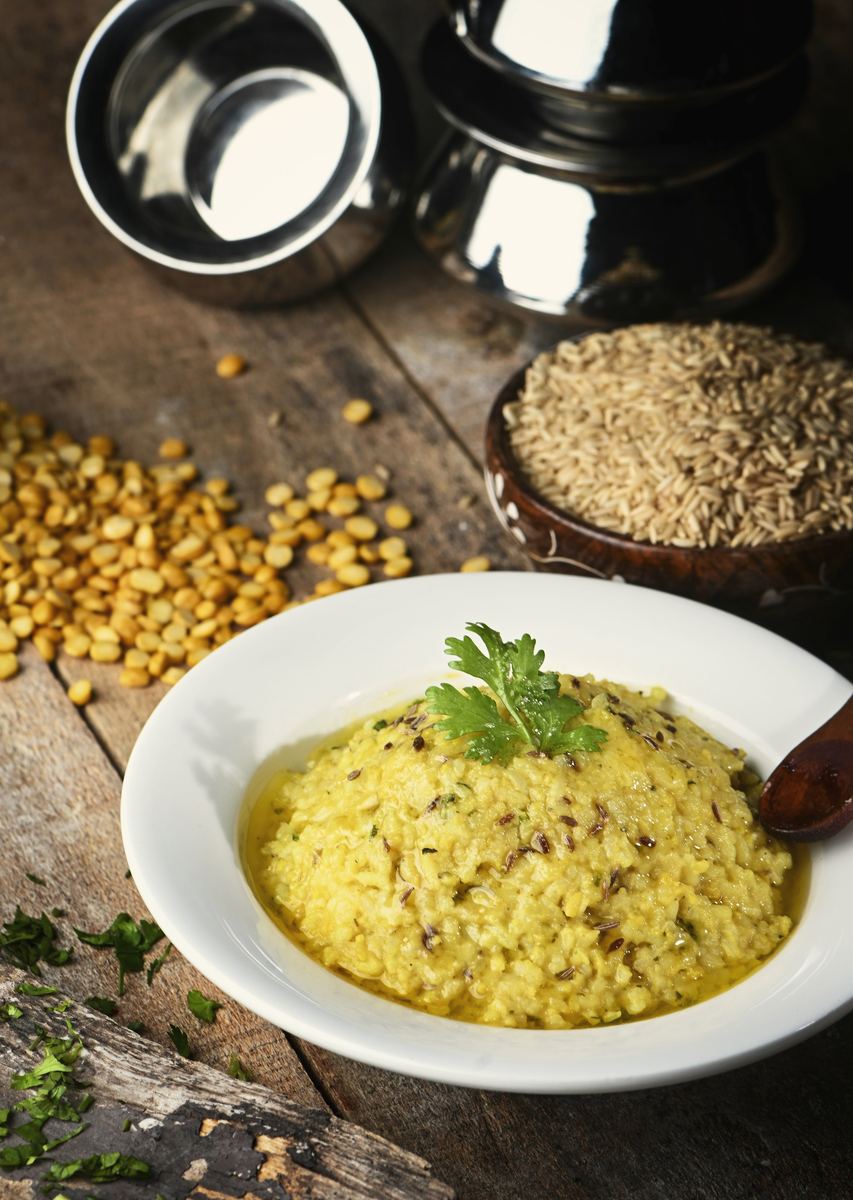
What kitchari is, how the classical Ayurvedic kitchen uses this simple rice-and-mung meal, and how to cook it at home.
In short
- Kitchari is a one-pot meal of rice and split moong dal, cooked soft with mild spices.
- Ayurvedic kitchens turn to it on days when digestion feels tired.
- It is ordinary, nourishing food for a day or two, not a long single-food diet.
Try this today
Cook kitchari for dinner tonight: rice and yellow moong dal with a little ghee, cumin, ginger and turmeric.
Author: Swastik Editors Editorial review: Swastik Editors
Kitchari is the least exotic thing in this library. Rice and lentils, cooked to mush, in one pot. The internet has dressed it up as a detox miracle. The classical texts never mention it by name; their quiet job description belongs to a ladder of graded gruels that modern kitchari practice borrows from. This guide keeps both in their lanes.
What exactly is kitchari?
A one-pot porridge. White rice and split mung dal (yellow moong) cooked together in plenty of water until both fall apart, with turmeric, cumin, coriander, ginger, salt, and ghee folded in; the word itself means roughly "mixture," usually of two grains (The Ayurvedic Institute's traditional kitchari recipe). The standard version uses basmati or another white rice with split yellow mung dal, plus optional vegetables and a spice tempering in ghee (The Ayurvedic Institute's traditional kitchari recipe).
That is the whole technology. No powders, no protocols, no special equipment. Simple recipes like this are the ones that survive.
What does classical Ayurveda say about it?
Two things, and they are not the same claim.
First, the everyday traditional view: contemporary Ayurvedic teaching commonly describes kitchari as tridoshic, a meal considered suitable across vata, pitta, and kapha constitutions when prepared simply (The Ayurvedic Institute's kitchari recipe for balancing the tridoshas). Warm, cooked soft, mild in spice, easy to chew and easier to digest. That reputation is traditional, not tested.
Second, the classical medical role, which is narrower than the internet suggests. After shodhana (the cleansing procedures such as vamana, therapeutic emesis, and virechana, purgation), Ayurveda does not send patients straight back to normal food. It rebuilds digestion in stages: thin gruel (peya), then thick gruel (vilepi), then yusha, a legume-based preparation, then mamsa rasa (meat soup), before ordinary meals return — the sequence given as peya, vilepi, yusha, mamsa rasa in Charaka Samhita, Siddhi Sthana (peer-reviewed review of samsarjana krama, IAMJ, citing Si. 1/10-12 and 6/24). The review describes this samsarjana sequence as moving stepwise from simple preparations toward multi-nutrient formulations, with the foods chosen to restore digestive strength (agni) (peer-reviewed review of samsarjana krama, IAMJ).
The closest the classical literature comes to naming kitchari's ingredients is the legume-soup stage: the same review notes Sharangadhara Samhita (Madhyama Khanda 2/168) describing yusha as nourishing and easy to digest, and singling out mudga — green gram, mung — soup as suitable for those recovering from panchakarma (peer-reviewed review of samsarjana krama, IAMJ). That is a mung-dal soup inside a graded clinical diet, not a branded "kitchari reset." Modern kitchari practice borrows the grain-and-legume stages of this ladder; the texts themselves never prescribe kitchari as a cleanse.
There is even a small modern clinical study of that sequence. After vamana, patients followed the graded diet and the authors reported a significant rise in agni-related parameters along with weight gain as recovery proceeded (clinical study of samsarjana krama, WJPR). Small study, low-tier journal, but it is the closest thing to evidence in this whole topic. Note what it tested: the graded diet sequence as a whole, not kitchari as a standalone cleanse. That distinction is where most modern "kitchari detox" writing goes off the rails. If the agni concept is new to you, the agni and digestion guide explains it from first principles.
Is a kitchari-only mono-diet safe?
As food, kitchari is ordinary cooked food: rice, lentils, spices, ghee. That matters because the water fasts it gets compared to deliver no nutrition at all. Kitchari does: real calories, real protein, real fiber, in one soft-cooked bowl.
A mono-diet is a different question from a meal. A few days of simple eating is a dietary choice, not a fast, and as mono-diets go, kitchari is a gentler one because it at least delivers protein and fiber. Stretch one food to weeks and the gaps stop being theoretical: the nutrition profile shows essentially no vitamin B12 and little calcium (USDA-based nutrition data for cooked mung beans), and any single-food stretch omits whole nutrient groups that variety normally covers. There is no trial-tested "correct" length for a kitchari mono-diet, because there are no trials. Short, not long. Even the Ayurvedic Institute's own recipe page cautions that a kitchari mono-diet "can lead to constipation if taken exclusively for several days, as it is low in fiber," and suggests psyllium husks, oat bran, or prune juice away from kitchari meals if elimination slows (The Ayurvedic Institute's traditional kitchari recipe).
Two groups should be extra careful. If you manage blood sugar, kitchari is a starch-forward meal (rice contributes the most carbohydrate per serving), and no study has measured the dish's glycemic effect, so watch your own response and talk to your doctor before making it a staple (USDA-based nutrition data for cooked white rice). If you are pregnant, managing a condition, or taking medication, any restrictive eating stretch deserves a clinician's input first.
And the "detox" promise. Nobody has measured toxin removal from a kitchari cleanse, because "toxins" in that marketing has no measurable definition to test. The plausible benefits of a short kitchari stretch are boring and real, which brings us to the practical part.
Sources and details
The research in brief
Traditional Ayurvedic practice regards kitchari (soft-cooked rice and split mung dal with mild spices) as a reset meal for tired digestion; modern practitioners map it onto the classical graded post-cleansing diet. Modern evidence is thin: our literature search found no trial of kitchari or of a kitchari mono-diet; mung bean is well characterized nutritionally, but the dish is not studied.
More key points
- Kitchari is a one-pot porridge of white rice and split mung dal cooked soft with mild spices. Ordinary food, not a supplement or fast.
- Classical Ayurveda prescribes a graded samsarjana diet sequence (thin gruel, thick gruel, legume soup) that rebuilds digestion after cleansing procedures; modern kitchari practice maps the dish onto those grain-and-legume stages.
- No randomized trial has tested kitchari itself as a cleanse or mono-diet; the modern evidence covers its ingredients, not the dish.
- Nutritionally it is a sound, starchy meal: complementary grain-and-legume protein plus real fiber. But a weeks-long mono-diet leaves gaps.
- The honest version of the "reset" is replacement, not magic: simple home-cooked food instead of processed food for a few days.
What does modern research actually say?
Start with the empty chair. No randomized trial has tested kitchari as an intervention for digestion, weight, or anything else. Not the dish, and not a kitchari mono-diet. A literature search turns up ingredient research and classical-diet papers, but no trial of the dish itself. That is a statement about the state of the literature, and the state is: nothing.
This gap sits inside a bigger one. The US National Center for Complementary and Integrative Health notes that only a small number of clinical trials of Ayurvedic approaches have been published in Western medical journals, and that "few well-designed clinical trials and systematic research reviews suggest that Ayurvedic approaches are effective" (NCCIH, Ayurvedic Medicine: In Depth). Kitchari is not an exception to that pattern. It is the pattern.
What does exist is solid nutrition research on the ingredients. A 2019 peer-reviewed review of mung bean (Vigna radiata) describes it as an excellent source of protein, dietary fiber, minerals, vitamins, and significant amounts of bioactive polyphenols, polysaccharides, and peptides (Hou et al., Nutrients 2019). The same review catalogs reported effects (support for healthy blood sugar and lipid levels, liver-protective and immune-modulating activity), but those come from studies of the bean's compounds and extracts, not from feeding people bowls of kitchari (Hou et al., Nutrients 2019). Do not let a compound's lab resume become the dish's biography. For more on the bean itself, see our mung bean (mudga) page.
What is actually in the bowl, nutritionally?
Good numbers, no miracles. Cooked mung beans deliver about 105 calories, 7 grams of protein, and 7.6 grams of fiber per 100 grams (USDA-based nutrition data for cooked mung beans). Cooked white rice is the starch engine: about 130 calories and 28 grams of carbohydrate per 100 grams, with barely half a gram of fiber (USDA-based nutrition data for cooked white rice).
The pairing is old nutritional wisdom. Beans are low in the amino acid methionine while cereal grains are low in lysine, so rice and beans eaten together supply the full set of essential amino acids the body needs to build protein (Barbara Quinn on rice-bean complementarity, MedicalXpress; cereal lysine deficiency per Hou et al., Nutrients 2019). Cultures figured this out by appetite centuries before amino acids had names.
The spices (turmeric, cumin, coriander, ginger) are what make the pot taste like dinner instead of a formula. Their individual research literatures are separate questions, and the pinches in a pot of kitchari are not trial doses. Enjoy them as flavor.
Frequently asked questions
Does a kitchari cleanse detox my body?
There is no measured evidence for that. No trial has tested toxin removal from a kitchari cleanse, and NCCIH notes that few well-designed trials support Ayurvedic approaches for most conditions. Most reported cleanse benefits are anecdotal. If a short stretch of kitchari leaves you feeling better, the likeliest cause is the boring one: you replaced processed food with simple home-cooked food for a few days.
How long is it safe to eat only kitchari?
No trial has studied this, so there is no evidence-based answer, only judgment. As ordinary cooked food, a few days is a dietary choice, not a fast. Stretch it to weeks and the gaps show: the dish has essentially no vitamin B12 and little calcium, and single-food diets omit whole nutrient groups. Keep a mono-diet short, and talk to a clinician before going longer.
Can kitchari help me lose weight?
Untested. No trial has measured weight change on a kitchari mono-diet. Short-term drops on any simplified diet are mostly water and glycogen plus a calorie deficit from eating less interesting food. If weight loss is the goal, no single dish substitutes for a sustained eating pattern and activity, and no kitchari study says otherwise.
Is kitchari okay if I have diabetes?
Treat it as a starchy meal, not a health-food free pass. Cooked white rice carries about 28 grams of carbohydrate per 100 grams with almost no fiber, and the bowl stays starch-forward even with the dal. No study has measured kitchari's blood-sugar effect as a dish. If you manage blood sugar, watch your own response and discuss any diet change, and never any medication change, with your doctor.
Whole or split mung dal: does it matter?
Traditional recipes call for split yellow mung dal (dhuli moong), not whole green mung beans. The split, husked dal cooks faster and breaks down into the soft porridge texture the dish is known for. That is kitchen practice, not a tested health claim: no study compares the digestibility of split versus whole mung dal in kitchari.
Sources
- The Ayurvedic Institute — Kitchari recipe (traditional preparation)
- Peer-reviewed review of samsarjana krama with classical citations (IAMJ, 2020)
- Clinical study on effect of samsarjana krama related to vamana karma (WJPR)
- Hou et al., Mung Bean (Vigna radiata L.): Bioactive Polyphenols, Polysaccharides, Peptides, and Health Benefits (Nutrients, 2019)
- NCCIH — Ayurvedic Medicine: In Depth
- USDA-based nutrition data — cooked mung beans (100 g)
- USDA-based nutrition data — cooked white rice (100 g)
- Barbara Quinn on rice-bean protein complementarity (MedicalXpress, 2019)
Educational only. This guide is not medical advice. Talk to a qualified practitioner or your doctor before changing your routine, especially if you are pregnant, nursing, managing a health condition, or taking medication.